
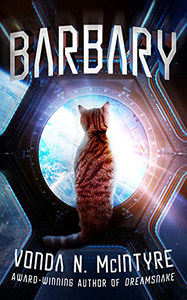
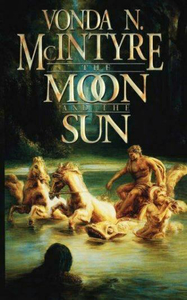
1986's Barbary is a straightforward and short Sci-Fi novel about the twelve year old Barbary moving to her new home on a space station just when an alien vessel is approaching it. She smuggles her kitten on board with her and doing so has an unexpected impact on Earth's first contact with an alien species. 1998's The Moon and the Sun is a historical fantasy set in the court of Louis XV. Marie-Josephé is a Lady-in-Waiting to the King's niece and her brother is his Natural Philosopher who has returned in triumph from the new world with a captive sea monster, a mermaid. As Marie-Josephé assists her brother is studying the creature she realizes that it is intelligent and she becomes determined to save it from becoming the King's dinner.
The most impressive thing about Barbary is that the world building and social commentary is so subtle, and the physics so light, that it's still a quick easy read suitable for all ages. As an orphan, Barbary is hardly more welcome than the kitten Mickey on Earth. The abuse she has suffered is deftly imparted throughout the story without ever focusing on it. On the station Einstein she is joining a college friend of her mother's and his daughter Heather, but she risks this new home to bring Mickey. Being a cat he manages to get himself, and Barbary, into trouble just as the first known alien spacecraft is nearing Einstein. One of the characters even mentions a similarity to the theme of Catch-22 where a rule breaking decision turns out to be for the best. The first contact situation is just as understated as everything else is but the aliens are unique and underscore the less admirable qualities of Humankind. The physics in the story is factual rather than speculative, and based upon actual models for space transport at the time it was written and still realistic today.
The Moon and the Sun earned McIntyre her third Nebula Award. Its similar in style to the historic fantasies of Guy Gavriel Kay although the writing isn't as lyrical or poignant. In this case the setting is France near the end of Louis XV's reign which is very well described and the details and personalities feel historically accurate. The fantastical element is the captured "sea monster", a mermaid that is physically closer to those in Gary Larson's The Far Side than Disney's The Little Mermaid. This fits with the overall theme of the book which focuses on the less than perfect physical attributes of the characters. Marie-Josephé is an extremely talented young woman, a mathematician, composer, sketch artist, and in general very well educated about the sciences. Sadly, this causes many, including her own brother, to believe that her mind has been overwhelmed by her studies when she tries to defend the mermaid as a sentient being. If I'd never read the Guy Gavriel Kay novels of the late 90's I would probably be more impressed by The Moon and the Sun. Granted, this is a well researched period piece of fantasy and definitely has a deeper subtext about human nature regarding those that don't conform to physical and social norms, but Kay's books are much more entertaining.
The Moon and the Sun is also being released as a movie on Jan 21, 2022 under the title The King's Daughter. I wouldn't have guessed this was the same story from the casting and trailer, there is no resemblance at all. The Moon and the Sun has 4 stars on Audible, Barbary has better reviews at 4.5 stars. Anna Fields who narrates Barbary also voiced Vonda McIntyre's novel Dreamsnake as well as some of the older novels by Catherine Asaro.